More than a rebrand, it marked the beginning of a new era for the institution.
“What’s in a name?” This was a question that brought a reckoning that forever shaped the history of Miriam College. While this year commemorates the school’s centennial, it also marks 37 years since it changed its name from Maryknoll to Miriam. The journey surrounding this moment was filled with challenges, resistance, and ultimately, acceptance.
From religious to lay
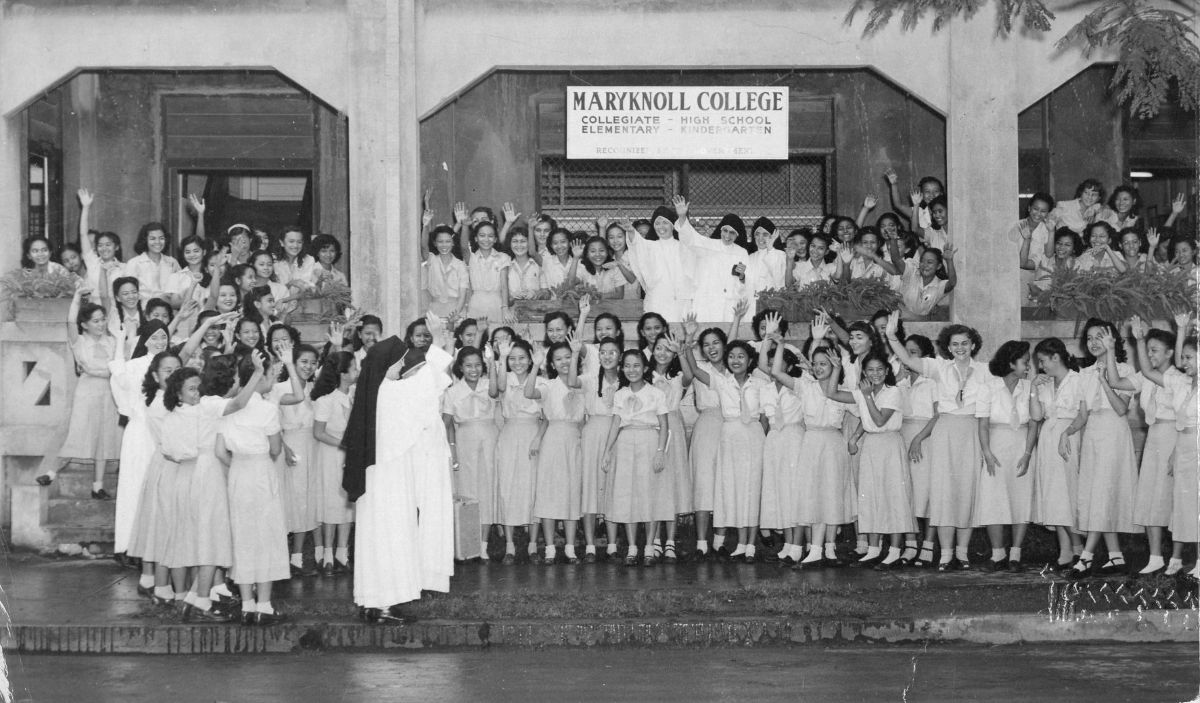
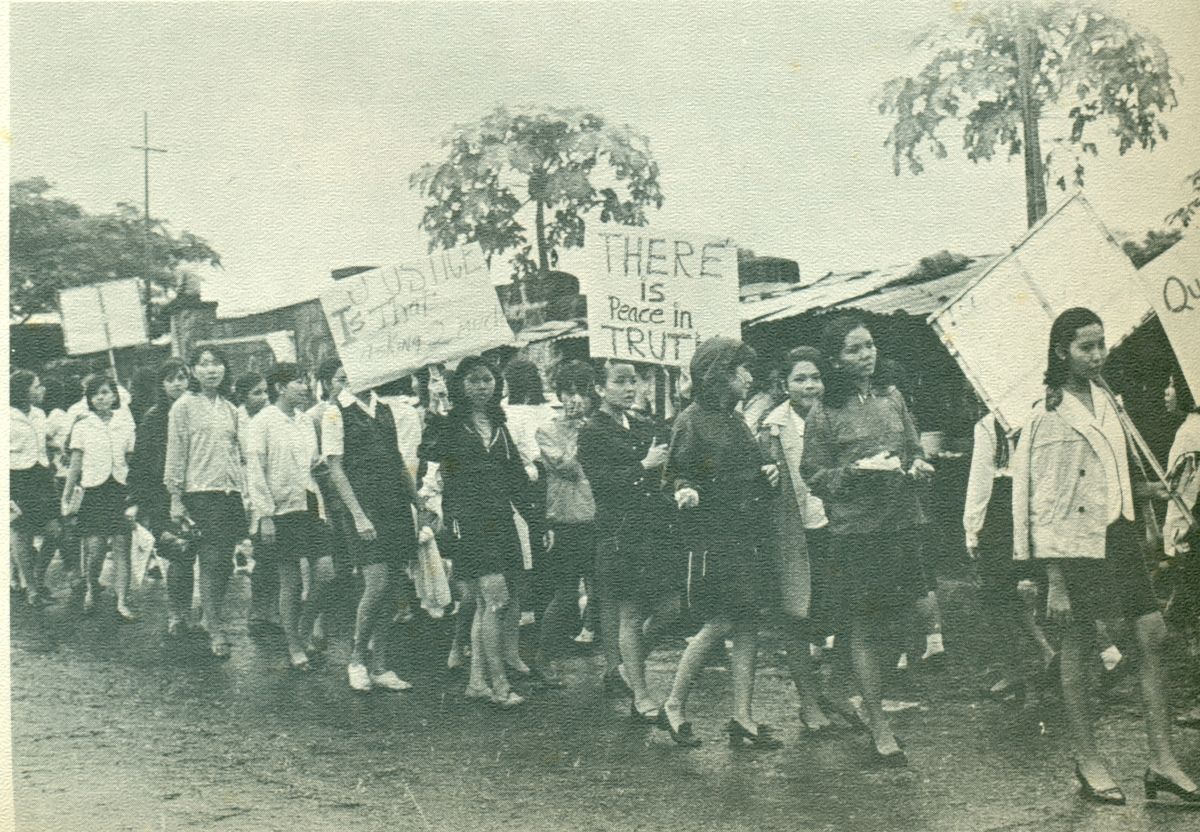
The name Maryknoll, which also means “Mary’s Hill,” comes from the name of the congregation’s hilltop property in Ossining, New York which still serves as the Maryknoll Sisters’ headquarters today. In many of their foreign missions in education, the Sisters would use the appellation for the schools they established in countries like Hawaii, Hong Kong, and the Philippines. For the latter, it would be a name proudly associated with a premier Catholic women’s school for decades until the inevitability of a name change, the reason of which is traced back to 1965. This was the year the Second Vatican Council (Vatican II) called on all religious congregations for a recommitment to serving the poor, making the Maryknoll Sisters rethink their roles in the College.
Sr. Teresa “TD” Dagdag, MM, an alumna of Maryknoll College and one of the most active Maryknoll Sisters in the Philippines in the last 60 years, attributes the Roman Catholic Church’s shift in mission to the influences of Liberation Theology which started in Latin America. The movement essentially called for the liberation of the poor and oppressed from social, political, and economic injustices. “Marami masyadong mahirap, dehumanized, and marginalized (that the movement asked the religious) ‘let’s go to them’; in education you can’t do that,” she said.
But, the Maryknoll Sisters in the Philippines were well-loved and respected so much so that when it was time for them to redirect their mission to the sectors sidelined by society, there was resistance coming from all directions—the students, parents, alumni, lay administrators, and the Maryknoll Sisters themselves.
“Muntik nang mag-split ang Maryknoll sisters noon,” Sr. TD recalls. “Many wanted to go the traditional way (serving in schools) and others wanted a different direction.”
In the end, the nuns dutifully heeded the call of the times and, in phases, paved the way for the transfer of the ownership of Maryknoll College to the lay. In 1969, the first College lay board was installed, followed by the incorporation of the school as Maryknoll College Foundation, Inc. (MCFI), with Sr. Miriam Thomas Thornton as its last president from the religious congregation.
Presidential Decree No. 176
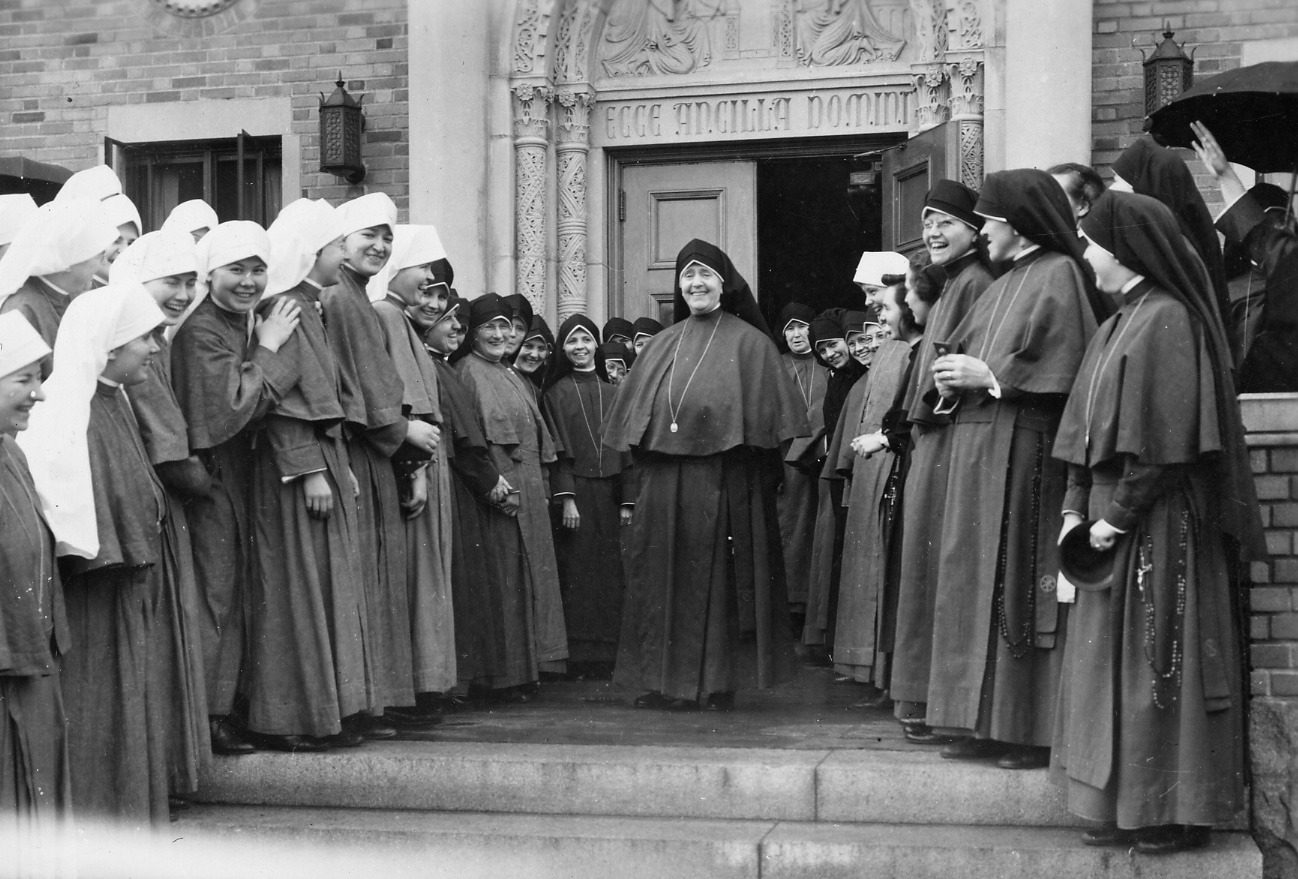
The transition became more inevitable when, in 1973, then President Ferdinand Marcos, Sr. amended Presidential Decree No. 176 which mandated that all educational institutions should be owned, controlled, and administered by Filipino citizens by school year 1976-77. So, in 1976, exactly 50 years after administering and running Maryknoll College, the Sisters fully turned over the reins of the school to a lay administration.
By this time, many Sisters in the Philippines were sent to different missions across East Asia, Southeast Asia, Latin America, and Africa, living and serving among farmers, migrants, sex workers, indigenous peoples, laborers, and the elderly among many other sectors.
From wearing a full habit that only showed their faces, they shifted to a modified version with shorter skirts and veils until eventually they stopped wearing the religious garment all together. They wore everyday clothes to avoid the privileges associated with the habit and to blend in with the communities they served. Sr. TD herself, after teaching at Maryknoll College and La Salette in Santiago, Isabela, was assigned to Hong Kong and worked among factory workers to understand their plight. “Mission is really an equalizer,” she reflects. “We go to people who don’t have enough, to make them whole.”
From Maryknoll to Miriam
As the Maryknoll Sisters settled in their new ministries, the lay administration of the College went to task continuing the work that the nuns have started. However, the more difficult work looming before them was renaming the school. The stakeholders of the school understandably protested the move. Reflecting the sentiments of the alumnae and student communities, the lay administration negotiated with the Sisters to retain the Maryknoll name. This pressure fell under the leadership of Dr. Lourdes Quisumbing, the school’s second lay president who eventually served under President Corazon Aquino as Secretary of Education, Culture, and Sports. She successfully managed to appeal the extension of the use of the Maryknoll name twice—from SY 1978-1983 and SY 1983-1988. However, a third appeal under the school’s third lay president Dr. Loreta Castro, was rejected when the Sisters unanimously voted that changing the College name should not go beyond April 1989.
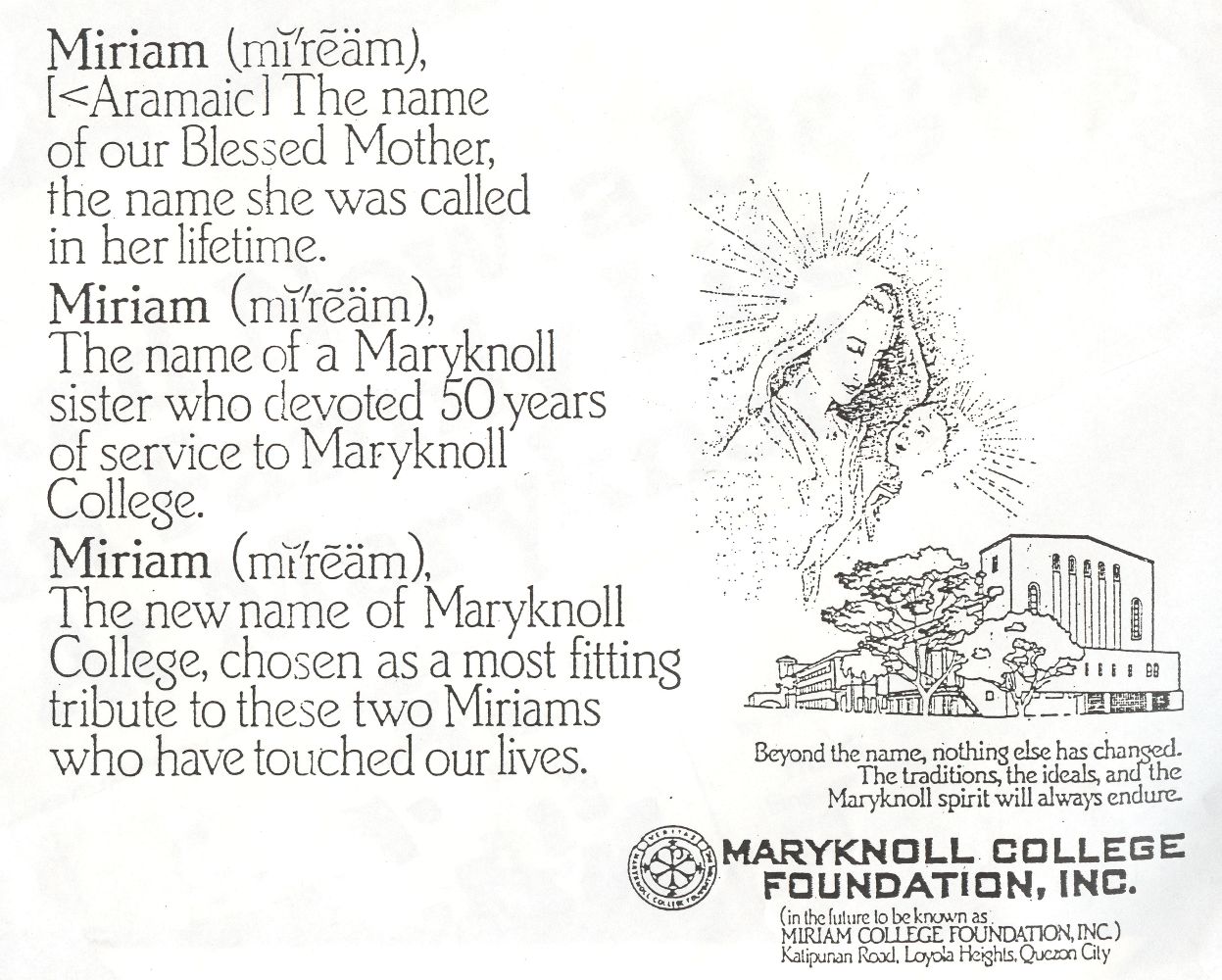
To meet this deadline, a series of consultations were held until the community finally settled on Miriam College, a fitting name inspired by the two Miriams beloved by school—Mother Mary whose Aramaic name is ‘Miriam’ and Sister Miriam Thomas Thornton, the longest serving administrator of the College.
Reflecting on this challenging period in the school’s history, Sr. TD affirms that it was all worth it. “Seeing Miriam College thrive confirmed our decision was right. And we did it while it was on a high crest. Ngayon, sa akin, if we did not turn it over, I don’t think we (the Maryknoll Sisters) can manage all of those different branches,” she says. Apart from its Loyola Heights campus—which is one of only two remaining schools in the country with an all-women’s college, the other one being Assumption College—the last 15 years saw the school open two more co-educational campuses, Miriam College Nuvali in Laguna in 2014 and Miriam College Alviera in Pampanga in 2025.
A name that endures
Even after 37 years, the name Maryknoll is still very much intertwined with Miriam. In fact, students still call themselves Knollers. This profound connection to the name may be attributed to the consistent presence of visiting Sisters on campus who, to this day, would share the trailblazing efforts of the American nuns especially in women’s education.
The very first Maryknoll Sisters came to the Philippines in 1926 upon the request of the 27th Archbishop of Manila, Michael O’Doherty. Through a letter to Maryknoll Foundress, Mother Mary Joseph, the Archbishop asked the New York-based congregation if they could ‘train quality Catholic teachers who could integrate values that would counter the growing secular spirit.” The Philippines then was under American rule and the Archbishop was worried over the increasing “proselytizing by Protestant missionaries,” referring to the Thomasites.
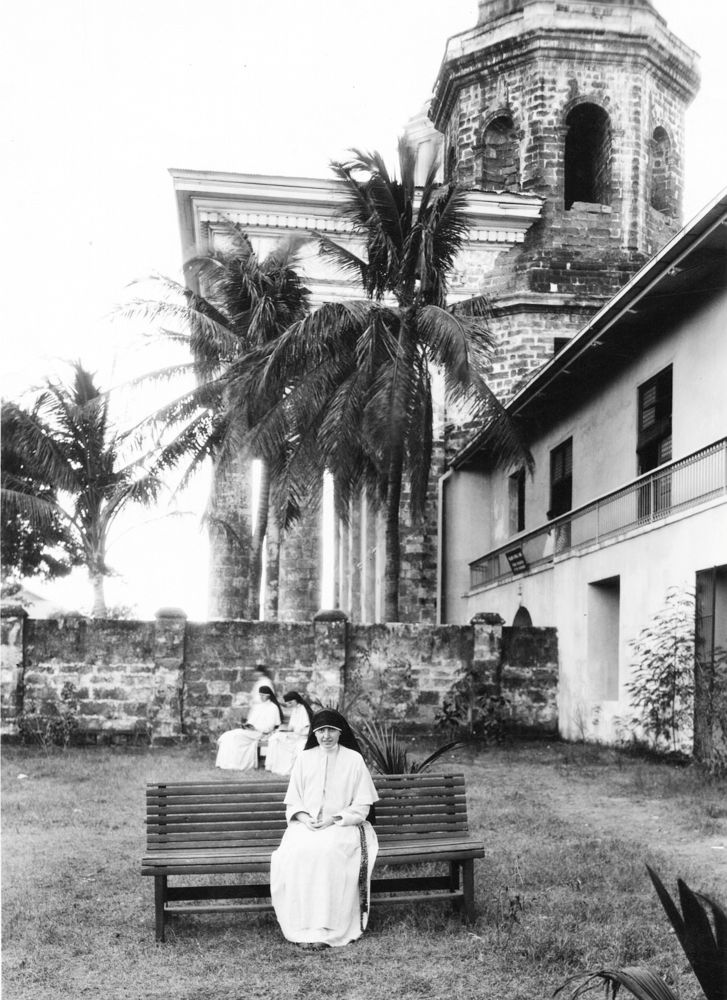
Undaunted by tropical heat and financial constraints, the Sisters managed to convert an old Augustinian convent in Malabon into a teacher training school called the Malabon Normal School (now St. James Academy) and by 1930, successfully produced their first four women graduates. From this single mission in Malabon, the Maryknoll Sisters’ work in education flourished throughout the Philippines. At the height of their mission, they were administering 18 schools around the country, including Lucena Catholic School in Quezon Province (now Maryhill), Maryknoll Convent School in Baguio (now Maryknoll Ecological Sanctuary) and La Sallete in Isabela.
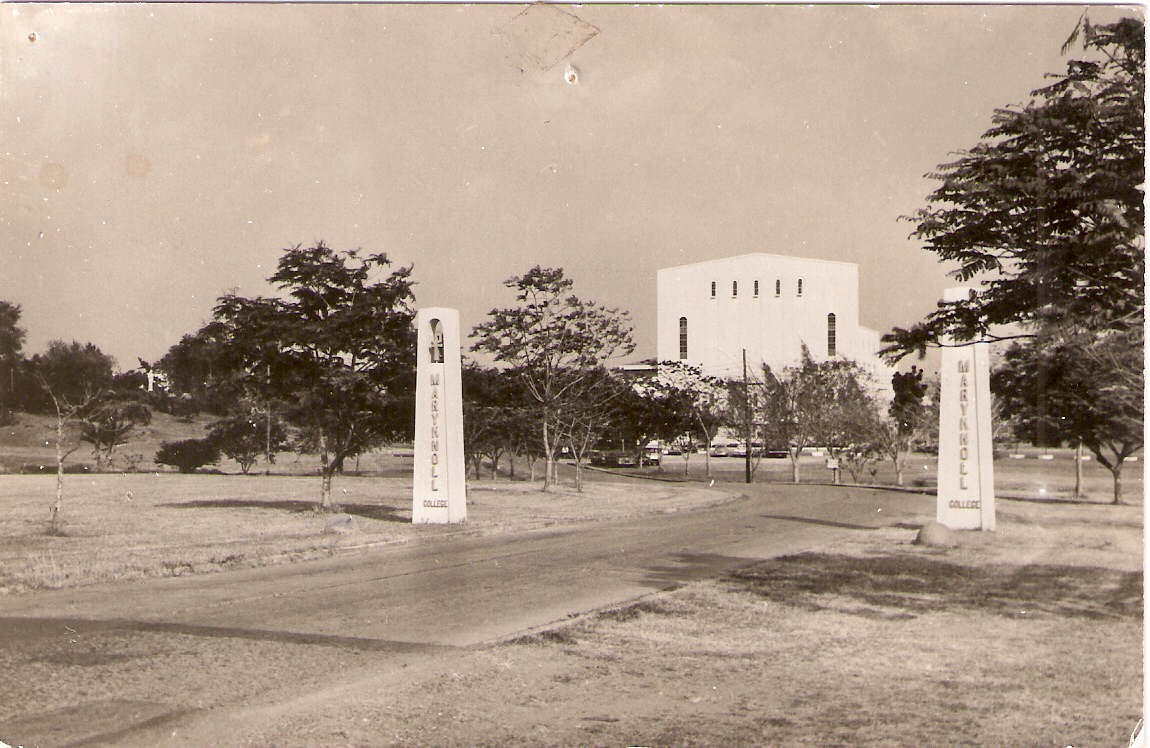
Their first school in Malabon was later named Maryknoll College which transferred to several sites after the war until finally finding its permanent home in an 18-hectare property in Diliman, Quezon City. Of all their missions in the Philippines, Maryknoll College, was “undoubtedly the most prominent work of the Maryknoll Sisters in the Philippines, with more Sisters assigned there as administrators and faculty than in any other educational institutions they maintained,” documented the book Maryknoll Sisters in the Philippines written by Virginia Fabella, MM and Dorothy Mulligan, MM.
Influence of the American Nuns
What attracted parents who enrolled their daughters in the women’s school then was an American-style education that was “democratic, liberal, and broad-minded” and that taught their children to “speak English well,” wrote Sisters Fabella and Mulligan.
“The Maryknoll/Miriam education I experienced was steady, formative, and clear about what it means to grow as a whole person,” says newly-inaugurated Miriam College President Dr. Maria Regina Lucia M. Lizares of her early education in Maryknoll. “The formation I received shaped me into an authentic, straightforward leader. I try to see people for who they are, speak honestly even when the truth is uncomfortable, and offer support where it is wanted.” Having graduated in high school in 1984, Dr. Lizares was one of the last batches of students that had witnessed the presence of Maryknoll nuns on campus.
The Sisters were also regarded as progressive and independent-minded. In her Philippine Daily Inquirer column At Large, the late Rina Jimenez-David, writer and Maryknoll alumna, fondly remembered that her classes were “distinguished by the way our teachers encouraged us to speak out and express our opinions.” In another entry, the women’s rights advocate elaborates on the Sisters’ influence on her formation by describing the nuns as “…a combination of daring and openness, even with hard-headed young women, and a devotion to serving the poor and the needy.”
Adaptable disposition
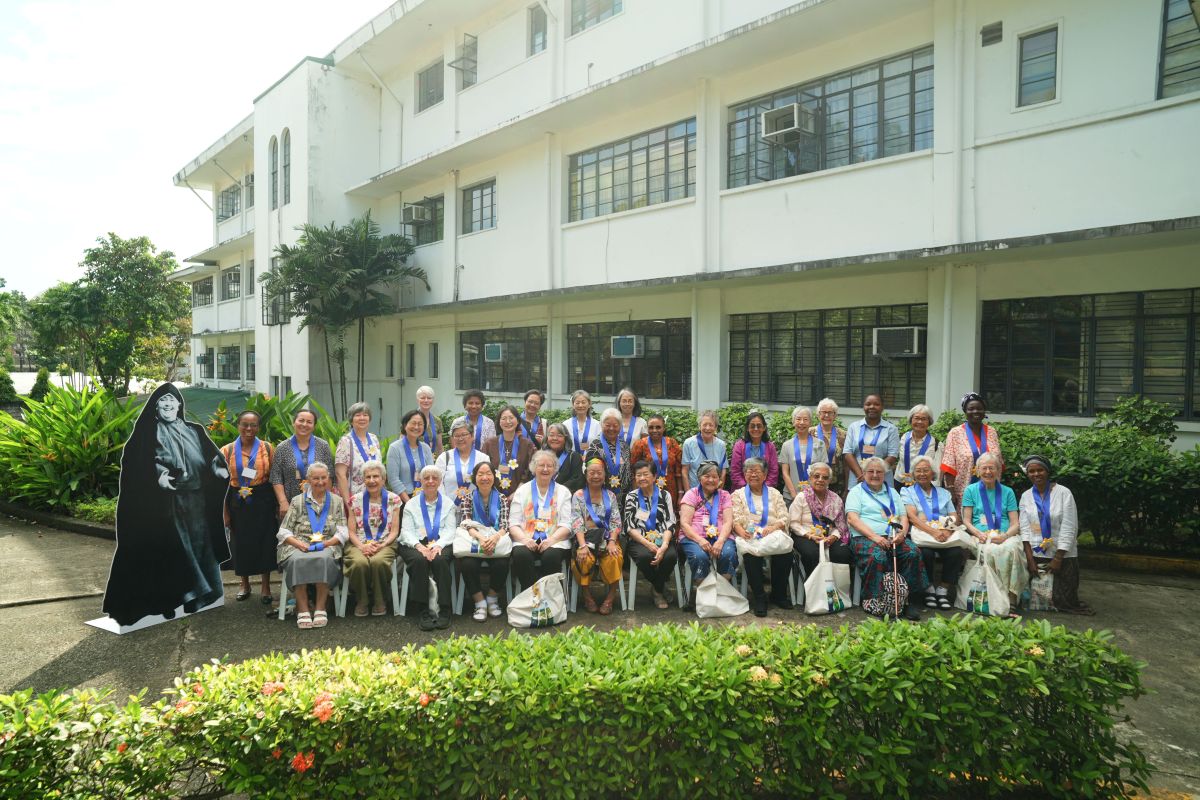
One hundred years later the Maryknoll Sisters’ continue their missionary presence and service in the Philippines. To celebrate this milestone, 36 Maryknoll Sisters from six different countries gathered at Miriam College last January for a Centennial Eucharistic Celebration. “We haven’t had so many Sisters gather in the Philippines in a long time,” says Sr. TD. There are 240 Maryknoll Sisters spread across the globe today and of this number, Filipinos comprise the second largest. Seven Sisters and three aspirants of different nationalities are currently based in the Philippines.
At the heart of the school’s centenary is the remembrance of its foundress; a deeply spiritual, forward-looking, and inspiring woman from Roxbury, Massachusetts—Mary Josephine “Mollie” Rogers aka Mother Mary Joseph. It was she who taught the Sisters the importance an adaptable disposition. “Adaptability is that power of creating anywhere we may be sent, the feeling of fitting in, and of attempting anything which we may be asked to do,” she would write in 1930, addressing the Sisters sent on foreign missions.
Maryknoll or Miriam, both names carry a herstory deeply shaped by both the religious and the lay. Its longevity and relevance can only be attributed to the quality its foundress so often talked about—an adaptable disposition “no matter the place, whether comfortable or not, that was Mother Mary Joseph,” says Sr. TD.
Note: The suffix MM after a Maryknoll Sister’s name means Maryknoll Missioner