

In a world increasingly defined by systemic shifts and complex crises, the classroom becomes a vital space for unlearning old paradigms and discovering new ways of knowing. At Miriam College, the International Studies graduate program facilitates the transformative journey of professionals from all walks of life as they find their place in the global story.
Eira De Borja never thought she would end up sitting in a graduate course on International Studies, debating colonial narratives and power structures with government officers, teachers, and advocacy workers. She comes from the finance sector, and this was very different.
But then, watching the world unravel in real time has a way of changing plans.
“Given the complexity and gravity of current global issues, I felt a growing need to understand what was happening around me and to do something, no matter how small,” she says.
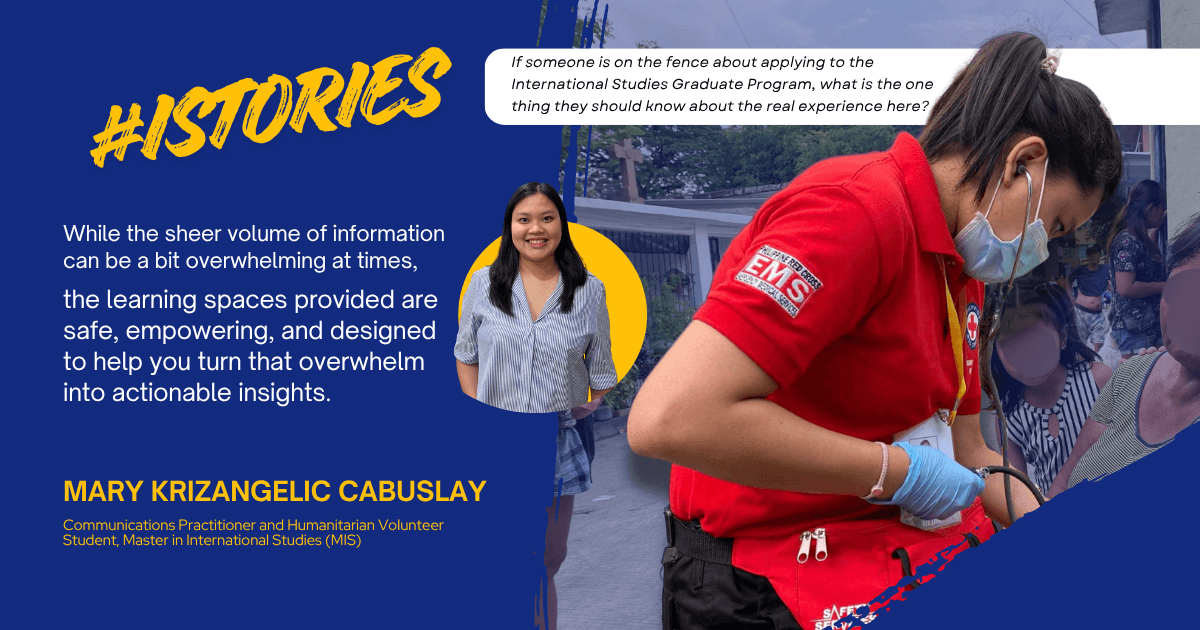
She’s not alone. There’s Mary Cabuslay, a communications practitioner who felt a growing frustration with disaster preparedness and resilience when she was volunteering for humanitarian work. “I am deeply dissatisfied with how global issues are being confronted,” she says, “and realized that I need to step up and expand my knowledge to take action beyond the four walls of the corporate world.”
Across Miriam College’s International Studies graduate programs, which include a Certificate Course and two master’s tracks, students are showing up with similar stories: successful careers in other fields, a gnawing sense that something isn’t right with how the world works, and a hunch that maybe understanding global politics differently could help.
What Happens When Finance Meets Development
What De Borja found at Miriam College was a community of learners. The faculty “have been both competent and diverse, constantly challenging me to think more critically, to share my opinions and experience, and to question them and engage deeply with my fellow students”, she says.
The readings are curated to resonate with global thinkers of the global South. “The lessons are unconventional, pushing me beyond mainstream assumptions,” she notes. “I am learning the importance of decentering colonial narratives and creating spaces for voices that have long been overlooked.”
It’s this kind of education that doesn’t let you stay comfortable. And for De Borja, that’s exactly the point. “Knowing is not enough,” she realized. “It must also be accompanied by a willingness to contribute meaningfully to these conversations.”
From Communications to Climate Justice
Cabuslay’s professional objective is to move into the corporate social responsibility space and focus on the environment and climate justice. Personally, she wants her advocacy to be authentic by making significant contributions to a sustainable and equitable society. “As someone who wants to utilize my voice in representing the underprivileged, particularly those who are heavily impacted by climate change, I want to advocate for these communities and ensure that there is authenticity in my advocacy,” she explains. The degree is no longer just for professional development; it is about making sure her work actually mattered.
Coming from communications without a background in International Studies, she felt the learning curve at first. But the faculty, she says, were encouraging about expressing insights and processing thoughts out loud. “They motivate us to do our own rigorous research,” allowing her to integrate her communications skills with global policy. More importantly, she realized she could “confidently contribute fundamentally important skills and knowledge from my background, which are deeply interconnected with our studies.”
The program expanded the scope of what she thought she was there to study. “Expanding my initial focus on climate justice and disaster resilience, I was able to recognize interconnected challenges that simultaneously impact not only the current generation, but also the generations to come.”
Finding Your Voice (And Actually Using It)
After three years in the program, Corinne Perdido can tell you exactly what changed: she learned to trust her own voice.
“The faculty has helped me sharpen my voice and trust it,” she says. And she’s not talking about some abstract academic exercise. Perdido works as a Training Specialist in the government, and so, what she learns on Tuesday night in class, she uses on Wednesday morning at work.
“Their lessons and feedback taught me how to think better, how to view global dynamics from different perspectives, while not sacrificing my personal views and opinions,” she explains. The result? “I’m more confident and more aware of how I present myself and how I articulate things,” she adds. And this also manifests at work, where she interacts with different individuals from different sectors.
It’s this kind of transformation that matters beyond the classroom. The faculty she describes as “progressive, deep, and forward thinkers” encouraged her to think differently, not simply what to think.
Moving Up Is a Sign of Leveling Up
For Eduardo Lim Jr., the logic was simple. After eight years of teaching high school, he knew exactly what he wanted to be next: to become a college professor specializing in International Studies. He also knew the hard truth: in the Philippines, staying a private-school high school teacher wasn’t going to get him there.
“Not taking a master’s degree program would be a major disadvantage as well as a professional challenge that would hinder those interests,” he says. So in 2024, he rolled the dice and enrolled.
One lecture stayed with him. In his International Peace and Security course, “it shifted my thinking on how analysts and political figures assess and prepare in relation to concerning geopolitical situations,” Lim recalls. Suddenly, he wasn’t just reading about conflicts. At that moment, he was learning how global leaders were analyzing the system: political, social, economic, technological, environmental, and legal dimensions. Short, medium, and long-term solutions.
But what really impressed him was the institutional culture. “Miriam College has one of the most accommodating faculty and staff I have ever interacted with,” he says. They don’t just teach and disappear. They provide “activities that encourage us to participate in programs and discussions as students and contributors to the Knoller Community, in whatever field we specialize and are passionate about.”
When Your Classmates Are Not Like You, Your Learning Horizon Expands
Ask Lim what the best part of graduate school is, and he won’t talk about the library or the facilities. He’ll talk about his classmates.
“Your classmates could be government officers, school teachers, analysts, advocacy workers, fellow academics, accountants, and more,” he says. And that matters because when you’re discussing an international trade agreement or a theory of economic development, the accountant sees things the teacher doesn’t. The government officer brings a perspective that the academic might miss. The advocacy worker asks questions nobody else thought to ask.
Cabuslay shares this sentiment while emphasizing that the interactions with her classmates make it easier to learn abstract and complex concepts. “It is a great opportunity to interact with people with different lived experiences,” she notes. “Exchanging ideas and knowledge makes the theoretical concepts we learn much more tangible and applicable.”
Three Ways In, Multiple Ways Forward
That diversity isn’t accidental. The programs are structured to welcome professionals at different stages with different goals.
The Certificate Course is the most flexible, with 18 units that you can complete in a year. Even with our certificate program, you can begin specializing in Global Politics, Gender and International Development, or Leadership and Global Change. Finish it and decide later if you want to go deeper. If you do, those units count toward the full master’s.
The full master’s program goes in two directions. The Master of Arts in International Studies (MAIS) is for people who want to do serious research. With its 37 units of coursework and 6-unit thesis, students are inspired and equipped to contribute to the production of new knowledge in the field. The Master in International Studies (MIS) is for practitioners who want to apply what they learn directly to their work. It has 43 units with a capstone project instead of a thesis.
Different entry points. Different endpoints. Same core mission: to leave our organizations, our communities, our world, better than when we found them.
What You Should Know Before You Apply
If you’re thinking about enrolling, our students have some clear advice: show up ready to take the challenge.
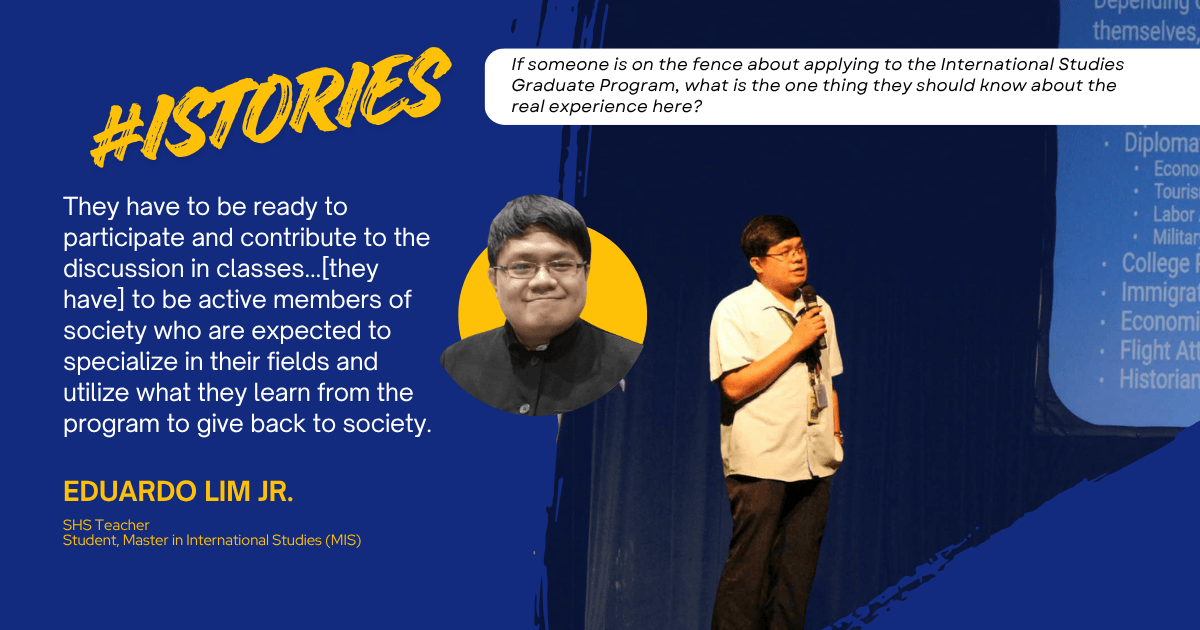
“They have to be ready to contribute to the discussion in classes,” Lim says. “The professional and personal insights of the class are important in the flow of the discussion.” This isn’t undergrad-level, where you can hide in the back and take notes. Graduate students here “are expected not only to be actively involved in submitting their requirements but also to be active members of society who are expected to specialize in their fields and utilize what they learn from the program to give back to society.”
Cabuslay highlights the need to be constantly updated to keep up with global developments and trends. “While the sheer volume of information can be a bit overwhelming at times,” she notes, “the learning spaces provided are safe, empowering, and designed to help you turn that overwhelm into actionable insights. Learning is more than just translating what we read, see, and hear into reality; it is about reflecting on what we can do and what we can offer.”
In other words: a total transformation from inside out.
That expectation runs through all four student stories. De Borja’s commitment to contributing meaningfully, Cabuslay’s expansion of interest in intersecting issues, Perdido’s journey of finding and trusting her voice, and Lim’s preparation to shape the next generation of students. They’re here not simply to observe, but to actively and purposively engage.
Why It Matters
The program title itself, International Studies, carries a certain gravitas. But talk to the students, and that’s not what they lead with.
What they’ll tell you about is the faculty who actually care. The classmates who bring and share their lived experiences. The discussions are challenging yet reinvigorating. The readings that make you uncomfortable in the right ways. The realization that maybe the mainstream narratives you have been taught about development, security, and global order aren’t the whole story, or even the sole story.
Miriam College, located in Loyola Heights, has built something unusual: a graduate program in International Studies that doesn’t just teach you to understand how the world works, but actively encourages you to question whether it has to work that way.
In a world increasingly defined by conflict, displacement, inequality, and ecological crisis, that kind of education is necessary, now more than ever.
For people like De Borja, Cabuslay, Perdido, and Lim, the program offered something they couldn’t find elsewhere: a community of people taking global challenges seriously, asking difficult questions, and refusing to accept easy answers.
If that’s what you’re looking for, you know where to find it.
The Basics:
- Certificate Course: 18 units, completed in 1 year if full-time, can transition to a full master’s
- MAIS (Academic Track): 37 units of coursework + 6 units thesis
- MIS (Professional Track): 43 units with capstone project
Specializations: Global Politics, Gender and International Development, Leadership and Global Change
Get in Touch:
Miriam College
Katipunan Avenue, Loyola Heights, Quezon City
coll-admission@mc.edu.ph
(+632) 8930-6272
mc.edu.ph